1)
Thermal Properties
Thermal Conductivity
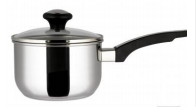 This is the ability of a material to conduct . A good is one that allows heat to flow freely. A poor thermal conductor can also be called a good . and Stainless are good conductors of heat which is why they are often used for body of sauce pans.
The handle of a sauce pan needs to be made from a material that is a conductor of heat.
2)
Thermal Expansion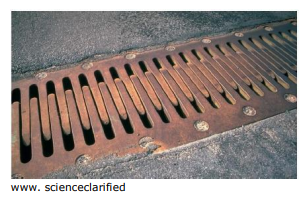 Changes in temperature can affect theof an object. The degree to which it expands or contracts depends on the material's coefficient of thermal . Materials with a high coefficient of expansion will increase in length/area/volume more compared to a material of a lower coefficient. A material when heated and when cooled. There is are a few exceptions to this, an obvious one being, expands when frozen due to its hydrogen bonds
3)
Melting Point 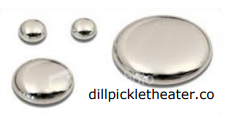 A changes to a at a specific temperature called the melting point. When an application involves heat, it is important to appreciate the temperature at which a material . It is also very important for materials, where molten metal is poured into a mould. For polymers, it is not just the melting temperature that is low, but the temperature at which it softens is called the transition temperature; both need to be considered when choosing polymers for applications.
Metals are solids at room temperature, however is an exception because its melting point in
4)
Electrical Properties
Electrical Resistance and Resistivity
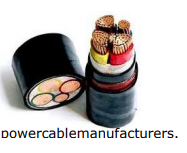
Resistance is the measure of the ability of a material to resist the passage of electricity; it opposes the flow of electrons. This is the opposite of . Materials such as wood, rubber and plastic have high resistance. Resistivity is a measure of a material's electrical resistance and takes into account area and which affect the resistance. Resistivity is the of electrical Conductance.
5)
Electrical Conductance and Conductivity 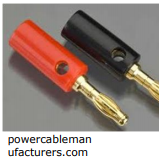 A good conductor of electricity allows to flow easily. are good conductors of electricity in particular copper and . Gold is a very good conductor, and has an additional advantage that it does not . Silver is the best electrical conductor but is not used because it is . Electrical Conductance is the measure of how well it conducts for its (area and length). Conductivity is a property of the material taking into account the size. There is a relationship between conductance and resistance, and conductivity and resistivity.
6)
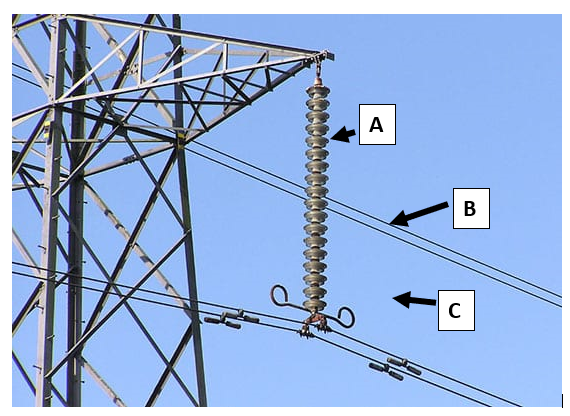
Use the picture below to answer the following questions
8)
Dielectric Strength
The dielectric strength of a material is a measure of the electrical strength of an . It is defined as the maximum required to produce a dielectric breakdown through the material and is expressed in terms of per unit thickness.
The dielectric strength is measured in kV/mm or kV/cm. For example when a material has a dielectric strength of 25kV/cm, it means that the maximum voltage or potential difference which 1 cm thickness of material can withstand without breaking it. When the voltage exceeds 25kV then a large value of current will flow and it will rupture the said material.
Typical insulators with high dielectric strength
- Air - 30 kV/cm
- Paper (oiled)- 200 kV/cm
- Paraffin - 350 kV/cm
- mica - 500 kV/cm
- glass - 1000 kV/cm
Uses of materials with high dielectric strength
- The mica is used as a good insulator for electric motor windings and its stator bars.
- For high voltage transformers and transmission line connectors, glass and porcelain are widely used.
- Naptha or paraffin oil is used when it is necessary that the insulator should be in liquid form, like in the case of transformer and large circuit breakers.
9)
Ferromagnetism
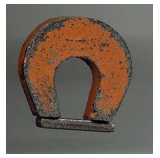 Ferromagnetism is the basic mechanism by which certain materials (such as iron) form permanent magnets, or are attracted to magnets. Ferromagnetism is the strongest type; it is the only type that creates forces strong enough to be felt, and is responsible for the common phenomena of magnetism encountered in everyday life. Soft Magnets are those that become magnetic when subjected to a magnetic field. Nails can be picked up with a magnet because of this effect.
Check box questions - Which of the following materials (more than one) are easily magnetised
a.
10)
What does Steel have in it which would enable you to use a magnet to help you distinguish between it and Aluminium?
11)
Metallic Lustre Metallic Lustre This is the ability of a material to be highly so that it can heat and light. So it is not only to make an object look visually good, but it also serves a purpose.
13)
Optical Properties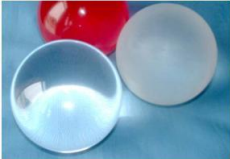
and plastics are utilised for their optical properties. Some materials are required to be which allows all the light through. The glass on the window in a living room is transparent, but for a bathroom this might not be so desirable. glass such as Frosted glass is typically used to allow some light through, but make visibility through it difficult. is when a material is unable to transmit light, and you cannot see through it, wood and metals are examples.
14)

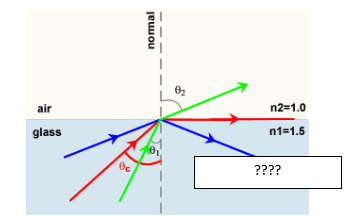
Optical fibres are very important in data communication.
a)What optical phenomena enables light to be transmitted along cables, across oceans. See the right picture for clues.
a.
15)
Optical fibres can be made of glass which is very fragile, what is used to coat the fibres to make them more flexible and less brittle?
16)
Mechanical Properties
It is very important to understand what mechanical properties are when selecting a material for an application. An engineer needs to understand what types of forces are occurring on a structure to be able to appreciate what properties need to be considered and what stresses the material needs to be able to withstand. There are four key types of force direction that can be applied to a material. Label the sketch and explanation correctly out of the following:
18)
Drag the boxes onto the matching gaps.- Shear
- Compression
- Tension
- Torsion
19)
Malleability
This is the ability of a material to be deformed by without rupture. i.e. it is the ability of a material to be hammered into shape or rolled in all directions. The on an aircraft need to be malleable, so Alloys are used, but care needs to taken as they can get work hardened.
20)
Which of two of these metals are considered to be malleable
21)
DuctilityA material like is known as ductile - it can be drawn out into a wire without fracture. A ductile material will plastically deform and stay permanently in its stretched state. Ductile failure is where a specimen starts to and fails in or close to the region of a stress/strain curve.
22)
Brittleness Materials that are brittle are very easily . They rather than deform. From a failure point of view, there is very little of the onset of failure (unlike necking on ductile materials) and they tend to fail in the region of a stress/strain graph. and Cast Iron are brittle materials.
23)
Stiffness and Strength
When a force is applied to a structure ( lets imagine a rod for simplicity), the effect of that force will depend on the stiffness and strength of that material itself. The stiffness and strength of a material both take into account the cross sectional area being subjected to a force. Stiffness is how much a material will extend or deform when a force is applied. Titanium has a modulus of elasticity (stiffness) of 180 000 MPa while rubber has a value of 100 MPa. Stiffness can also be used for flexibility, so how much does a beam bend with an applied force on top. Strength is the maximum stress that a material can take before the onset of failure. If an engineer knows the cross section of cable, then by knowing the materials Ultimate tensile strength (stress at which a material starts to fail), they can determine the maximum Force that the cable can take before breaking. Yield strength is also important as this can be used to calculate the maximum force before the cable would start to plastically deform.
Formulae Strength is the maximum Stress Stress ` ` = F/A where F=Force and A=cross sectional area subjected to the force
The units for stress are N/m² (N.m-2 ) which is also called a Pascal (Pa) Stress is usually a large number in terms of N.m-2 so stress is usually quoted in MPa or GPa.
Strain ` `= ` ` which is the change in length / original length. Strain has no units because the units cancel out.
Strain is usually a very small number so is often quoted as a % or in µstrain (microstrain)
24)
Engineering prefixes useful for mechanical properties
25)
Density
This is an important property for many applications which might require a light weight or heavy materials. Materials used for the structure of aircrafts need to be strong, stiff, fatigue resistant and in density. are often used because they have a density of 2200 g/m^3 compared to steel which has a density of ~ 8000 kg/m^3. Density is the amount of mass per unit . Ice cubes float, because water expands when it freezes and the density reduces.
26)
The environment
A lot of reasons that a material is suitable for a particular application is down to how it withstands the environment of where it is to be used. When ever a material is going to be used outside, exposed to the elements and in particular moisture, it needs to be resistant to . Near the sea, or in the desert (which was once under the sea) can increase the rate of corrosion due to being in the air. Some metals are inert, and do not oxidise easily so is often used as a coating for high quality connectors because it does not oxidise. produces an oxide layer that is self protecting, unlike iron that produces a flaky oxide layer called that can weaken a structure.
Polymers in particular can be susceptible to Ultra-Violet degradation and discolour and become brittle. Temperature can also have an effect; cold temperatures can make some materials changes from being ductile to , Some materials will soften or melt at higher temperatures; some polymers for instance will soften at 50°C.
Exposure to chemicals, such as oils, alkalines and acids can also cause a material to degrade, so what a material is cleaned with or whether a material will be exposed to fuels or oils is important to consider.